FIELD NOTES BLOG
Take a Walk with All Your Senses!
Have you ever gone on a "Senses" walk?
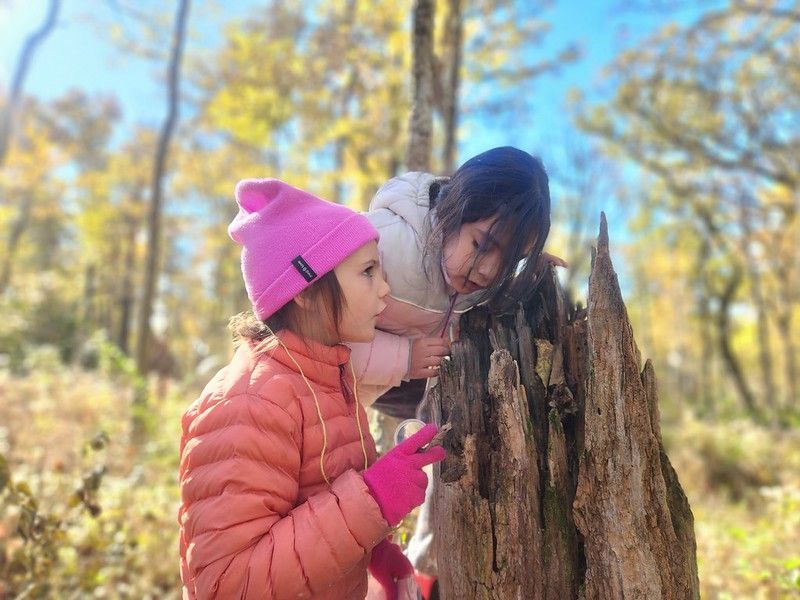
When you hear the words “senses walk”, a lot of things probably come to mind. There are countless articles about things like forest bathing or mindfulness walks, but when you use those bigger words, it can feel intimidating. And something that is intimidating isn’t something we as humans typically want to try. However, when you truly break it down, a mindfulness walk is really just tuning in to all your senses while you are out in nature, and using simple activities, you can turn any walk into a senses walk!
There are five basic human senses: sight, touch, hearing, smell, and taste. Each sense is associated with a different organ that transmits information to our brains to help us make sense of the world around us. By working together, these senses clue us in to our world–what is good to eat, what is dangerous, what is calming, what attracts us, etc.
Research has also shown that those without one of the five senses, for example those that are born blind, have brains that create new connections to enhance their sense of hearing, smell, and touch.
Did you feel that?
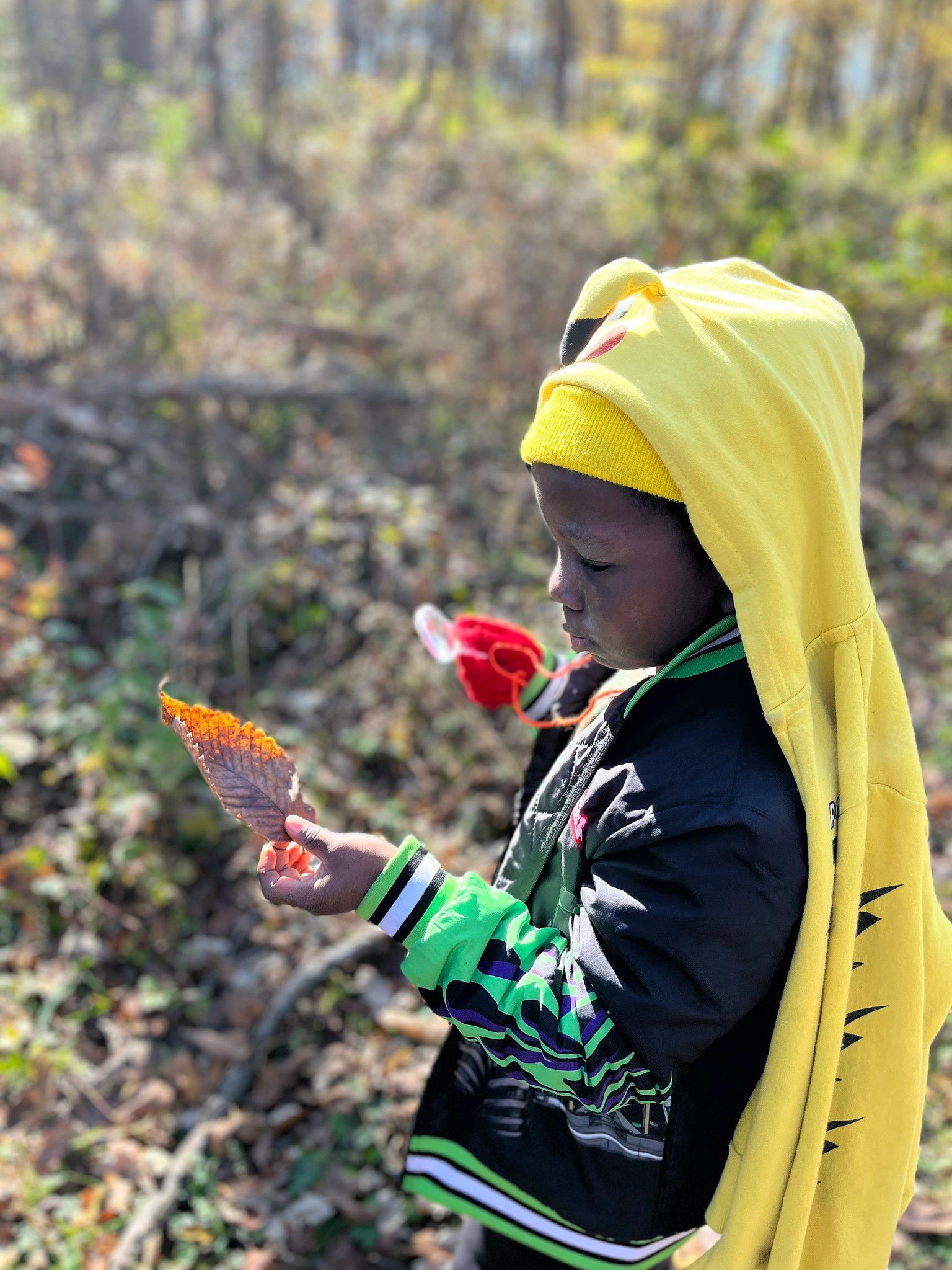
Touch is thought to be one of the first senses that humans develop. Through touch, we can sense pressure, temperature, vibration, pain, and pleasure. Touch conveys compassion as well as survival. Through this sense we are able to tell the difference between a soft cuddly kitten and a prickly porcupine!
Activity Ideas: When out in the woods take a moment to allow your sense of touch to take over. Run your fingers through the grass. Touch a leaf of a prairie dock. Hold a smooth stone in your hand. Feel the breeze and the sun on your face. Focus on what the ground feels like under your feet (with or without shoes if it is safe!).
Wow, did you see that?
Sight is a very complex process involving our eyes. Using reflected light, messages are sent to nerve cells at the back of our eyes which are sent as electrical signals to our brain telling us what we are seeing. Different parts of our eyes use the light to interpret color (cones) and the amount of light entering (rods). Putting that all together helps our brain form a picture of what we are experiencing.
Activity Ideas: Scavenger hunts are a great way to dial in your sense of sight. You could try by seeing how many “orange” things you can see in one walk. Or maybe try seeing all the colors of the rainbow. Use your sense of sight to discover patterns in tree bark. For a different kind of sight experience, take a night hike with Severson Dells and allow your night vision to take over!
What was that noise?
Our sense of hearing is quite complex. And I don’t mean in the way that children, pets, or partners sometimes have “selective hearing” where you know they hear you, but just aren’t listening! Complex in the way that a sound wave has seven steps to process before making it to the brain! It starts with our outer ears where the sound wave is caught and funneled into the ear canal. The wave then reaches our ear drum where a thin sheet of connective tissue vibrates when the waves strike it. This vibration causes three small bones (in fact the stapes is the smallest bone in the human body!) in the inner ear to vibrate. These vibrations are sent to the Corti organ, which is covered in tiny hairs. These hairs turn the vibrations into electrical impulses which travel to the brain!
Activity Ideas: While out in the woods, try creating a “sound map”. Sit still in one place and on a piece of paper, make a mark around you every place you hear a sound. Try listening for the closest sound you can hear and then focus on what the furthest away sound you can hear is. If you want to deepen your understanding of the impact on sound in nature, consider attending a “sound walk” with the
Midwest Society for Acoustic Ecology, based in the Chicagoland region.
What is that smell?
Did you know there is a specific word for the smell of soil after it rains? That is called petrichor and it is one of my favorite smells! To get from the ground to the brain, perceptions of smell begin on the roof of the naval cavity. Nerve endings transmit signals to the olfactory bulb in the brain, where they are interpreted as smells. It was often thought that humans were only adequate at smelling compared to other mammals like dogs, but new research is emerging that shows humans might be just as smelly…I mean, might be just as good at smelling as dogs!
Activity Tip: One of the reasons why dogs were long thought to be the better smeller is due to their wet nose. Moisture allows a better activation of those olfactory receptors, so try dampening your nose just a bit before smelling something delicious like bergamot, or gray headed coneflower!
What a delicious taste!
Taste has long been associated with our survival as a species. Things that taste bitter are often poisonous, things that are sweet might be high in nutrients. Taste is sensed by clusters of taste receptor cells called “taste buds”. Adults have between 2,000-4,000 taste buds, and they are not only on the tongue, but also in the throat, your uvula (the flap of skin that protects your windpipe), and in your nasal cavity. It has been disproven that your tongue has specific zones for each taste, but each taste bud is “programmed” to have a different level of sensitivity to the different tastes. Our sense of taste can be broken down into 5 main categories of perception: salty, sweet, bitter, sour, savory. Smell is also very important to taste through a process called oral referral.
Activity Tip: The biggest tip here is: don’t taste something in nature unless you are 110% sure of what it is! Many edible items have almost identical lookalikes to things that can make you sick. Follow educators like
Black Forager, or learn with a nature guide before venturing out to taste anything in nature.
Finally, in addition to the traditional big five senses we just read about, there is another sense that is called “proprioception” which is the sense of determining where your body is in space. You can see how important this sense is by trying to walk in a straight line with your eyes closed! It is a combination of all of our senses working together to create a working body in the world around us. To work on enhancing your proprioception you can close your eyes and balance on one leg. Brush your teeth with the opposite hand. Or my favorite, roll down a grassy hill!
In conclusion, our senses are what enhance our world around us. Next time you are out in nature, try focusing in on one of your senses and see how it changes your experience! If you are interested in learning more about Sensory Science, consider attending
Severson Dells Science Saturday on February 7th from 10-2pm! This event is free for the community!
Sources and Links:
Clinic, C. (2023, December 6). Forest Bathing: What it is and its potential benefits. Cleveland Clinic. https://health.clevelandclinic.org/why-forest-therapy-can-be-good-for-your-body-and-mind
Brain “rewires” itself to enhance other senses in blind people | Department of Ophthalmology. (2017, March 22). https://eye.hms.harvard.edu/news/brain-rewires-itself-enhance-other-senses-blind-people
Sutton, J., PhD. (2025, July 28). Mindful Walking & Walking Meditation: a restorative practice. PositivePsychology.com.https://positivepsychology.com/mindful-walking/
Bremner, A., & Spence, C. (2017). The development of tactile perception. Advances in Child Development and Behavior, 52, 227–268.https://doi.org/10.1016/bs.acdb.2016.12.002
Midwest Society for Acoustic Ecology. (2026, January 16). Home | Midwest Society for Acoustic Ecology. Midwest Society for Acoustic Ecology | Exploring the Role of Sound and Listening in Natural and Cultural Environments.https://mwsae.org/
Rutgers University. (2017, May 11). The Human Sense of Smell: It’s Stronger than We Think. https://www.rutgers.edu/news/human-sense-smell-its-stronger-we-think
Black Forager: https://www.instagram.com/blackforager/?hl=en
Harvey, A., Bradford, A., & Cooke, E. (2024, June 10). The 5 human senses — and a few more you might not know about. Live Science. https://www.livescience.com/60752-human-senses.htmlNew Paragraph

RECENT ARTICLES