FIELD NOTES BLOG

What Will You Give This Giving Season?

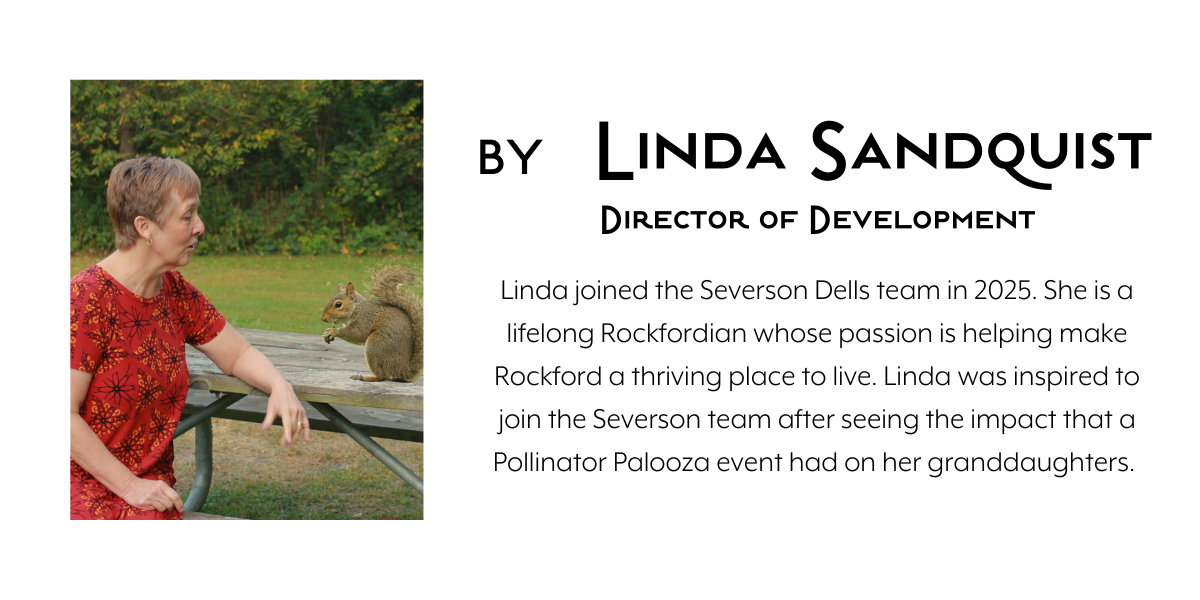
Linda Sandquist
November 21, 2025

As the leaves change colors and fall to the ground and the temperatures dip below freezing, we can feel the calendar tumbling toward the end of the year. Soon the Thanksgiving feast will be just a memory, and we’ll bring out our menorahs, Christmas trees, Kawanza candles, yule logs, and whatever else we use to bring light into this season of shorter days and longer nights. 


As the days swirl past Thanksgiving, many people observe other “holidays” like Black Friday, Small Business Saturday, Cyber Monday, and Giving Tuesday.  Giving Tuesday, December 2nd, gives us a reason to think about others and contribute to charitable organizations that support causes near and dear to our hearts.


As you consider your End of the Year giving and Giving Tuesday, we at Severson Dells encourage you to be generous to a fault. Political and economic uncertainty have negatively affected not-for-profit agencies and people’s needs have grown. If you are concerned about food insecurity, give to a food pantry. If you want to make sure someone has a roof over their head, give to a shelter or employment program. Education, animals, the arts, medical research – there are dozens of ways you can support a better community.


And, of course, if you believe that nature education is important, please consider giving to Severson Dells. We are living in a world where more and more time is being spent head down on screens and less time heads up in nature. When you give to Severson Dells, you invest in curiosity and creativity, and the many other benefits people receive by being in the natural world. You support the discoveries both children and adults make in the great outdoors. You help sustain environmental stewardship and a pathway to better mental and physical health. Your gift makes a difference!


Wishing you a delightful giving season. 


Severson Dells is a 501(c)3 organization. Our EIN is 36-2985870. We accept DAFs, IRA gifts, appreciated stock, real estate, and cash gifts. You can also join our recurring giving club to make your giving easy and predictable. 


Questions about giving? Call me at 815-335-2915 or email me at linda@seversondells.org

RECENT ARTICLES
By education2.americorps February 18, 2026
Have you ever looked around and wondered about grass? It may not seem like there’s much to notice about the common golf course, front lawn, sidewalk adjacent sort of grass we see everyday, but if you look below the surface there’s a whole world and history. These often monochromatic, sprawling green landscapes are planted with what is referred to as turf grass, such as Kentucky blue grass, a plant imported to the United States from Europe and North Africa. This style of lawn design was brought to the U.S. from Europe during the 1700s, where long expanses of short green grasses were associated with the manicured country estates of the wealthy and upper social classes. The popularization of this cultural import co-occurred and played a role in the development of U.S. suburban culture in the late 1800s, strengthening through the mid-20th century when it became more widely actionable for people in the middle class. Turf grass now covers app. 40 million acres across the country(an area larger than the whole of Illinois). The planting of monoculture grass areas like this, where there are long stretches of only one kind of plant, came in contrast to the landscapes that grew for millenia on the place we now call the United States. These ancient landscapes were full of biodiversity, and in many areas housed ecosystems where humans functioned as just one part of a balanced set of biological processes. In Illinois specifically, native grasslands–in this region called prairies–used to cover 21 of Illinois’ 36 million acres on their own. Prairies in Illinois formed (and the .01% that still remain still form) unique and powerful living systems. Not only do they create a safe home for many animal species to go about their lives, their root systems push through soil to notable depths, with an average length between 5-15 feet, whereas the turf grass lawns discussed above have roots not digging more than 3-4 inches into the earth. The impact of these root systems is profound, creating long pathways for water absorption, microbial and mycelial growth, and the draw down of excess carbon from the atmosphere back into the earth. Just one acre of restored prairie can sequester(take out of the air and store in root systems) 160 tons of carbon a year, and absorb 65% more stormwater–or water left on the ground after it rains–than turf grass. The transformation of turf grass back to prairie has profound positive impacts on surrounding ecosystems. The restoration project at Elliot golf course will provide a prime example for residents of this region to watch as the land begins to come alive with the myriad colors, animals, and landscape benefits of a prairie in just a few years. Sources: https://www.sustainablewoodstock.org/a-history-of-the-american-lawn/ https://blog.nwf.org/2024/04/why-we-have-lawns/ https://www.fs.usda.gov/r09/midewin/natural-resources/forest-management https://www.chicagobotanic.org/blog/plant-science-conservation/lowdown-prairie https://www.chicago.gov/city/en/depts/water/supp_info/conservation/green_design/natural_landscaping.html https://files.dnr.state.mn.us/assistance/nrplanning/community/roadsidesforwildlife/putdownroots_poster.pdf https://www.onlyraindownthedrain.com/kids/ https://www.nature.com/articles/s41467-024-46991-5?fromPaywallRec=false
By Olivia Price February 18, 2026
Rivers move and snow falls and hillsides weather while tectonic plates settle snugly across the crust of our earth. The wind blows and trees bow down on stormy days, and deep under our feet the molten parts of our planet’s body flow, as above our heads we see the wispy clouds marking the flow of airs of our sky swirling just the same. Just beyond these skies we see the moving pinpricks and round splotches of light which cross our eyelines through each daily cycle, marking just one of the myriad multiscale rotations of our planet, solar system, and galaxy.
By education3.americorps February 11, 2026
What Are Plants Doing During the Winter Months?