FIELD NOTES BLOG

Flights of Fancy: Bird Bonanza, December 2

Liz Wiener
November 30, 2023

This fall, Severson Dells Nature Center saw the return of a beloved program, the monthly Science Saturday! This event has welcomed over 700 people to Severson Dells since returning in September of 2023. Thanks to the generous sponsorships of Collins Aerospace and Nicor Gas, Science Saturday has been able to bring in experts from UW Madison, Northern IL Raptor Rehab Center, Sinnissippi Audubon, the Monarch Conservation Society, and more. Participants of all ages have made crafts, tried their hands at predator challenges, and ignited a curiosity for science! But, we aren’t done yet! The final Science Saturday of 2023 will be on December 2, and it is sure to be a great time! Join us for the Bird Bonanza! 

Not to be outdone by the Saturdays before it, Bird Bonanza will have a little something for everyone to “tweet” about. All ages will enjoy spreading their wings and soaring to new heights. 
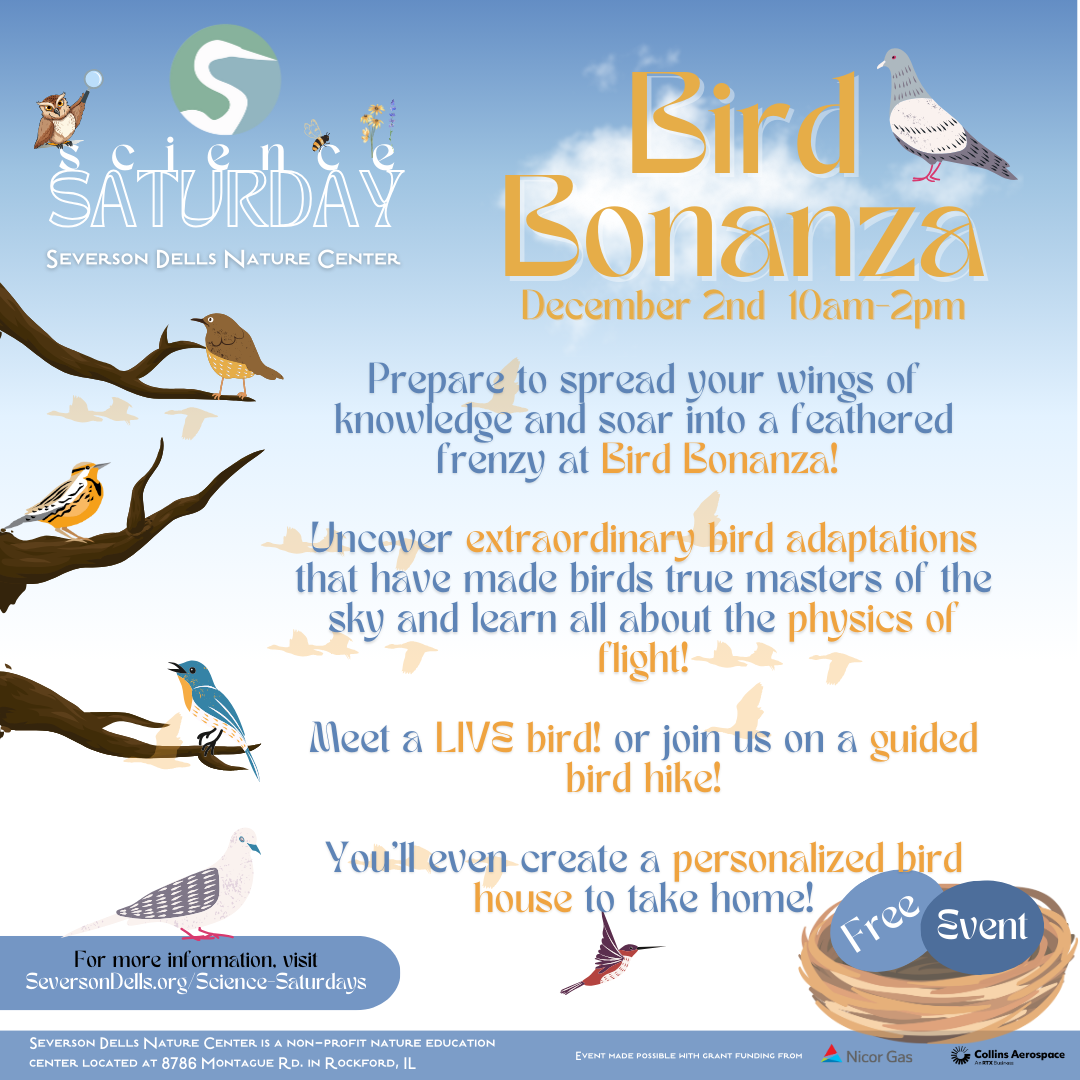
Join Severson Dells AmeriCorps members to learn about bird beaks, feet, and feathers. Get an up close look at these amazing adaptations that make our feathered friends so special! You’ll also be able to decorate a miniature bird house to take home! 


Are you interested in getting out on the trails and learning about how to use binoculars and spotting birds? Join Don Miller and Kevin Kaltenbach for a short birding hike around the Severson paved loop. They will lead two hikes throughout the day, and each will last about 30-45 minutes. 

Are you more interested in the sounds of birds? Join Micky Torpedo for a performance of his most recent album, Birdsongs, Vol 1 - Sounds of the Mississippi Flyway . This is an ongoing collaborative project between Micky and Sinnissippi Audubon Society. Their newest album, Volume 2, will be released in Spring of 2024. For this performance, Micky will be joined by Heather Camacho (The Lone Canary) on violin, Karl Ropp on upright bass, and Cade Eastham (Turning Stranger) on percussion. Micky and friends will be performing two sets throughout the day. 

Our friends from Rock Valley Garden Center will also be here with lots of information about how to best set up a winter feeding station for birds, and you’ll be able to make a pinecone bird feeder to take home for your yard or neighborhood! Sinnissippi Audubon will be present with great information about George and Louise, Rockford’s resident peregrine falcons! 

Hoo Haven will be bringing along one of their resident education birds for an up close look at our feathered friends. If you haven’t checked them out, Hoo Haven is a wonderful resource for injured birds, providing rehabilitation and education for birds of all shapes and sizes. 

Finally, Collins Aerospace will be here talking about the physics of flight, how the planes you see flying take inspiration from birds, and getting youth excited in the aerospace industry that happens right in our backyard! You’ll learn all about Bernoulli’s principle, match bird wings and plane wings, and even test out your own paper airplane against some real aerospace and mechanical engineers! Harin Patel, a mechanical engineer at Collins Aerospace and a huge asset in the grant that Severson Dells received to put on these Science Saturdays says of the event, “Collins Aerospace will be partnering with Severson Dells to teach students the Physics of Flight! We are extremely excited to teach students how flight works and apply these concepts to airplanes!”


We hope to see you fly on over to Severson Dells for our Bird Bonanza. As you can see, there is something for every member of your flock to engage in. Bird Bonanza happens December 2, 2023 from 10am-2pm at 8786 Montague Road in Rockford, IL. If you have any questions, please reach out to Liz Wiener, Public Programs Coordinator at liz@seversondells.org or call 815-335-2915.

RECENT ARTICLES
By Lauren Bonavia February 26, 2026
Rewilding the Former Elliot Golf Course
By Emma Zimmerman February 24, 2026
For those who may not know me, I previously spent two wonderful years here at Severson Dells working in environmental education and community science, helping our community connect with the land in meaningful ways. I am so excited to announce that I am back at the nature center for the next few months! In this role, I’ll be leading all things Science Communication, so be on the lookout for educational blogs, behind-the-scenes restoration updates, and social media posts that (hopefully) make ecology feel a little less intimidating and a lot more exciting.
By education2.americorps February 18, 2026
Have you ever looked around and wondered about grass? It may not seem like there’s much to notice about the common golf course, front lawn, sidewalk adjacent sort of grass we see everyday, but if you look below the surface there’s a whole world and history. These often monochromatic, sprawling green landscapes are planted with what is referred to as turf grass, such as Kentucky blue grass, a plant imported to the United States from Europe and North Africa. This style of lawn design was brought to the U.S. from Europe during the 1700s, where long expanses of short green grasses were associated with the manicured country estates of the wealthy and upper social classes. The popularization of this cultural import co-occurred and played a role in the development of U.S. suburban culture in the late 1800s, strengthening through the mid-20th century when it became more widely actionable for people in the middle class. Turf grass now covers app. 40 million acres across the country(an area larger than the whole of Illinois). The planting of monoculture grass areas like this, where there are long stretches of only one kind of plant, came in contrast to the landscapes that grew for millenia on the place we now call the United States. These ancient landscapes were full of biodiversity, and in many areas housed ecosystems where humans functioned as just one part of a balanced set of biological processes. In Illinois specifically, native grasslands–in this region called prairies–used to cover 21 of Illinois’ 36 million acres on their own. Prairies in Illinois formed (and the .01% that still remain still form) unique and powerful living systems. Not only do they create a safe home for many animal species to go about their lives, their root systems push through soil to notable depths, with an average length between 5-15 feet, whereas the turf grass lawns discussed above have roots not digging more than 3-4 inches into the earth. The impact of these root systems is profound, creating long pathways for water absorption, microbial and mycelial growth, and the draw down of excess carbon from the atmosphere back into the earth. One acre of restored prairie can sequester(take out of the air and store in root systems) 1 ton of carbon a year, and absorb 65% more stormwater–or water left on the ground after it rains–than turf grass. The transformation of turf grass back to prairie has profound positive impacts on surrounding ecosystems. The restoration project at Elliot golf course will provide a prime example for residents of this region to watch as the land begins to come alive with the myriad colors, animals, and landscape benefits of a prairie in just a few years. Sources: https://www.sustainablewoodstock.org/a-history-of-the-american-lawn/ https://blog.nwf.org/2024/04/why-we-have-lawns/ https://www.fs.usda.gov/r09/midewin/natural-resources/forest-management https://www.chicagobotanic.org/blog/plant-science-conservation/lowdown-prairie https://www.chicago.gov/city/en/depts/water/supp_info/conservation/green_design/natural_landscaping.html https://files.dnr.state.mn.us/assistance/nrplanning/community/roadsidesforwildlife/putdownroots_poster.pdf https://www.onlyraindownthedrain.com/kids/ https://www.nature.com/articles/s41467-024-46991-5?fromPaywallRec=false